
Entelligently V2: From Human Experience to Building Intelligence
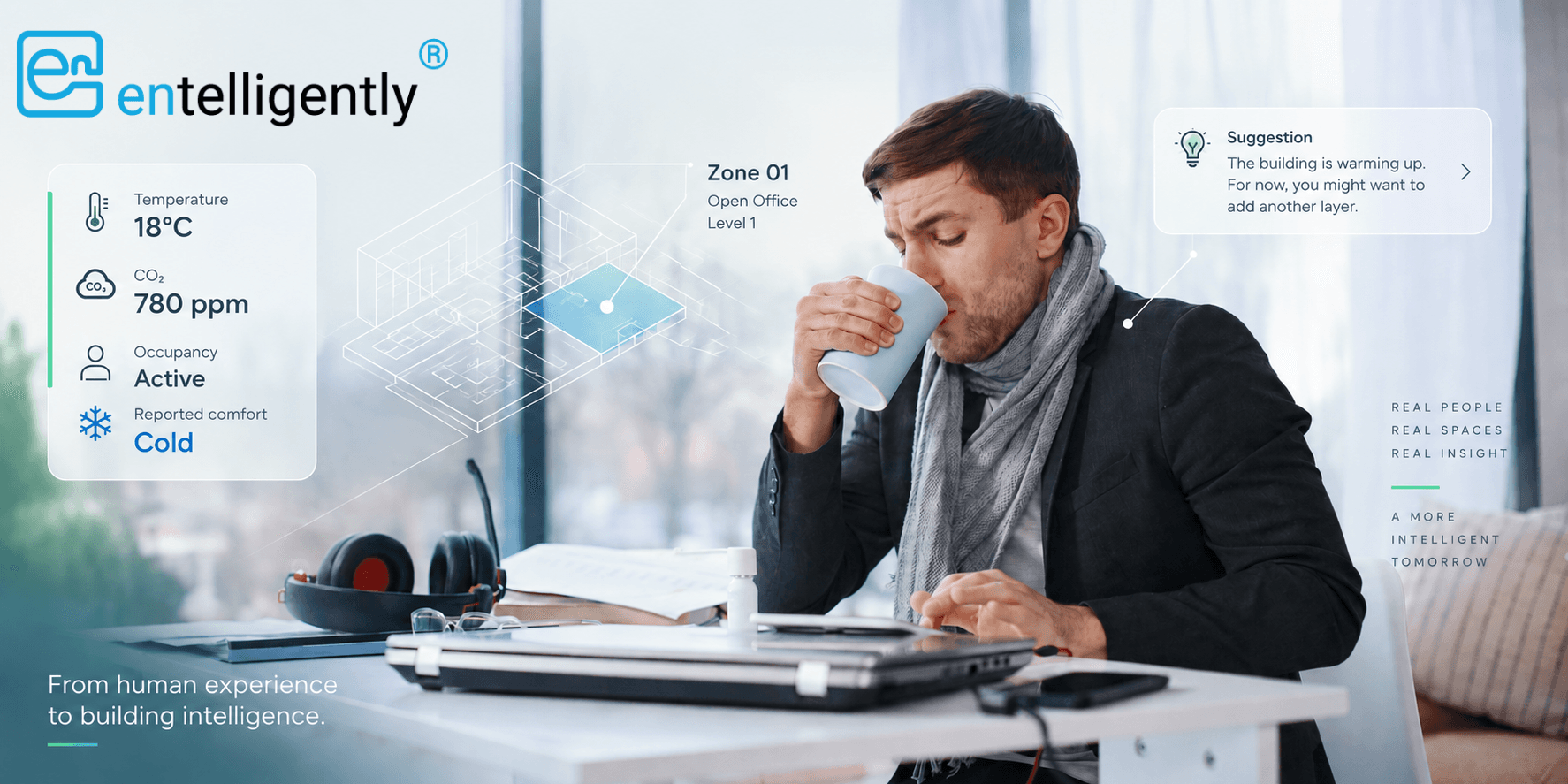
Entelligently V2 brings together how people experience a building with environmental data, connected building systems and spatial digital-twin information. The result is a richer understanding of how buildings are really performing — and a practical route from insight to action. We are now looking for organisations to explore that potential with us as trial partners.
The gap between a building that works and a building that works for people
Buildings are designed around specifications, models and assumptions. Temperatures, ventilation rates, occupancy levels, plant performance and energy consumption can all be calculated. Increasingly, they can also be monitored and controlled.
But once a building is occupied, something much less predictable enters the equation: people.
Two people sitting in the same room can experience it differently. A space that appears perfectly acceptable according to its environmental data may still feel too warm, too cold, stuffy or uncomfortable to someone working there.
Equally, a person can be uncomfortable even when the building is doing exactly what it was designed to do.
That creates an important gap between design intent and lived performance.
A building can be functioning correctly without necessarily working particularly well for the people using it.
That gap was the starting point for Entelligently.
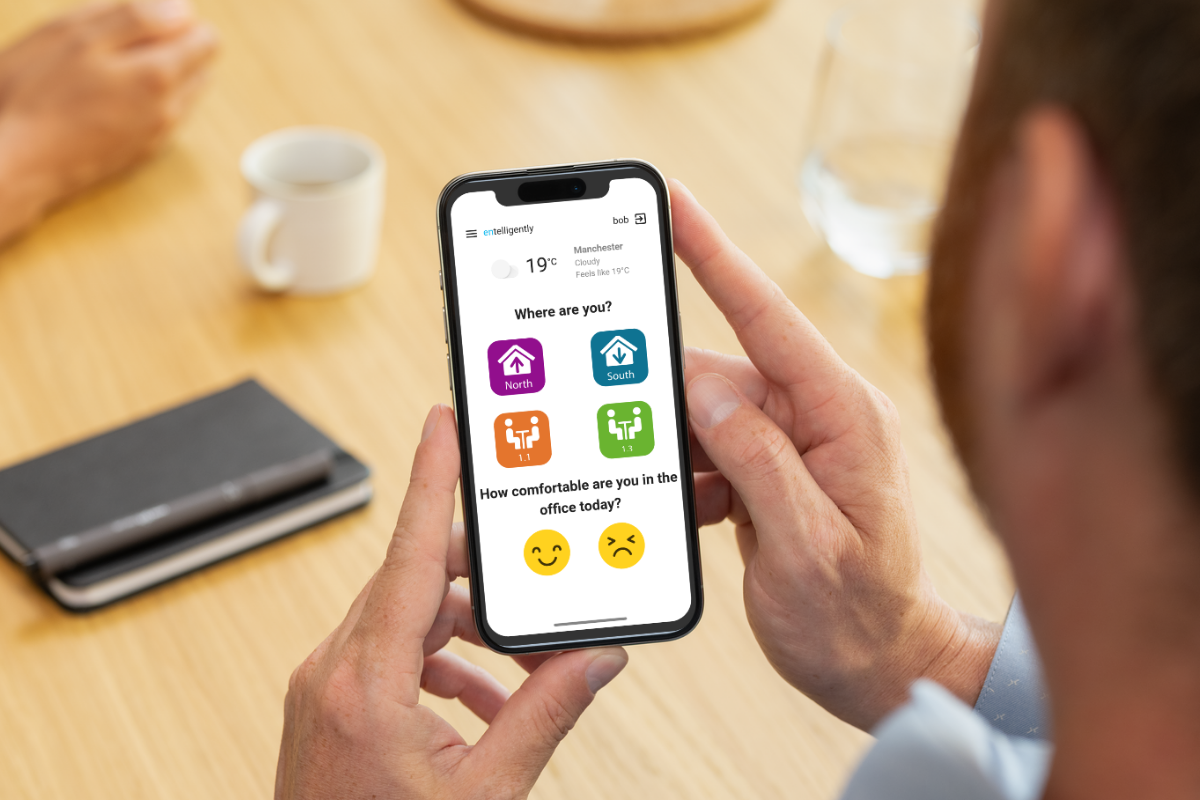
Rather than treating occupants simply as another variable to be modelled, Entelligently asks them directly how they are experiencing their environment.
Because however sophisticated the sensor network becomes, there is one thing the building cannot tell us on its own:
whether the person sitting inside it is comfortable.
The person can.
What the original Entelligently taught us
Entelligently was originally developed around a deceptively simple idea: combine what people tell us about their comfort with information about the environment around them, then use that combination to better understand building performance.
Real-building trials helped us discover how complicated, and potentially useful, that relationship could be.
One of the strongest examples came from the Bright Building at Manchester Science Park.
The September 2017 trial report shows why occupant feedback matters. In one area, for example, one user reported feeling cold and drafty at an indoor temperature of 24°C. Around 20 minutes later another occupant in the same zone reported feeling hot. The report suggested that the two users might simply not be well suited to the same environmental conditions.
There is no single temperature setting that makes those two experiences disappear.
That is important because conventional building management tends to work with zones, thresholds and setpoints. People do not.
The original work also changed some of our own thinking about the problem we were trying to solve.
Energy efficiency was an important part of the project, but our experience working with occupants suggested that the immediate concern for the person using the building was much more personal: How does this workplace make me feel?
We also saw value in simply giving people a way to report their experience.
Not every comfort problem can be fixed immediately. Sometimes the building cannot be changed at all. But giving an occupant a simple mechanism to say this space is too hot, I feel a draught, the light is bothering me or I'm becoming sleepy creates information that otherwise might never reach the people managing the building.
It also acknowledges the occupant's experience rather than leaving them simply to tolerate it.
Sometimes improving someone's experience of a building starts by giving them a voice.
A small intervention while the building catches up
Listening is useful, but the next question is what to do with what we hear.
Buildings have inertia.
Imagine an office becoming too warm during the afternoon. The building may already be responding. Cooling may have increased, ventilation may be changing or solar shading may be taking effect.
But the physical environment cannot necessarily change as quickly as the person sitting inside it would like.
That was the thinking behind one of the original Entelligently concepts: the Smart Nudge, or Snudge.
A Snudge is a small, proportionate intervention intended to help someone manage their immediate environment.
If conditions are likely to improve shortly, the most appropriate response might not be another intervention in the building systems. It might instead be useful to tell the person what is happening and suggest something they can do in the meantime: adjust a blind, move away from direct sunlight, use a nearby space for a short period or make another simple change appropriate to their circumstances.
The building may already be solving the problem. Entelligently can help the person understand what is happening and what they can do while it does.
This also creates an important distinction between a comfort response and a facilities-management problem.
Not every person feeling temporarily warm should generate a work order or cause an HVAC system to change its settings.
Sometimes the smartest intervention is a very small one.
The 2017 trial produced some encouraging early evidence. In all three instances examined in the September report, Snudges were followed by increased engagement the following day. The report also found more comfortable responses during a comparison week in which Snudges recommended actions than during a week in which they simply asked people to provide feedback.
The original report was appropriately cautious, noting that the effect remained to be proven, but concluded that the comparison suggested proactive Snudges prompting an action could have a positive effect on users.
V2 retains this human-scale approach but can now surround it with considerably more information.
V2: giving human experience much more context
The central idea behind Entelligently has therefore not changed.
It still starts with the person.
What has changed is how much we can potentially understand about what is happening around them.
We think about V2 in four progressively additive capabilities: Listen, Sense, Connect and Locate.
Listen is the human starting point. Occupants tell Entelligently how they are experiencing their environment and associate that experience with where they are.
Sense adds objective environmental information. Temperature, humidity, CO₂, presence, occupancy and other measurements can provide context around what the person is reporting.
Connect allows relevant information from the building itself to be incorporated. Depending on the deployment, that could include BMS or HVAC information, meters, IoT devices and other connected building systems.
Entelligently can also use technologies such as Home Assistant as an integration layer, creating potential routes to a wide range of devices and protocols without requiring a building to replace useful infrastructure it already has.
The precise integrations available will always depend on the equipment, systems and permissions within an individual building.
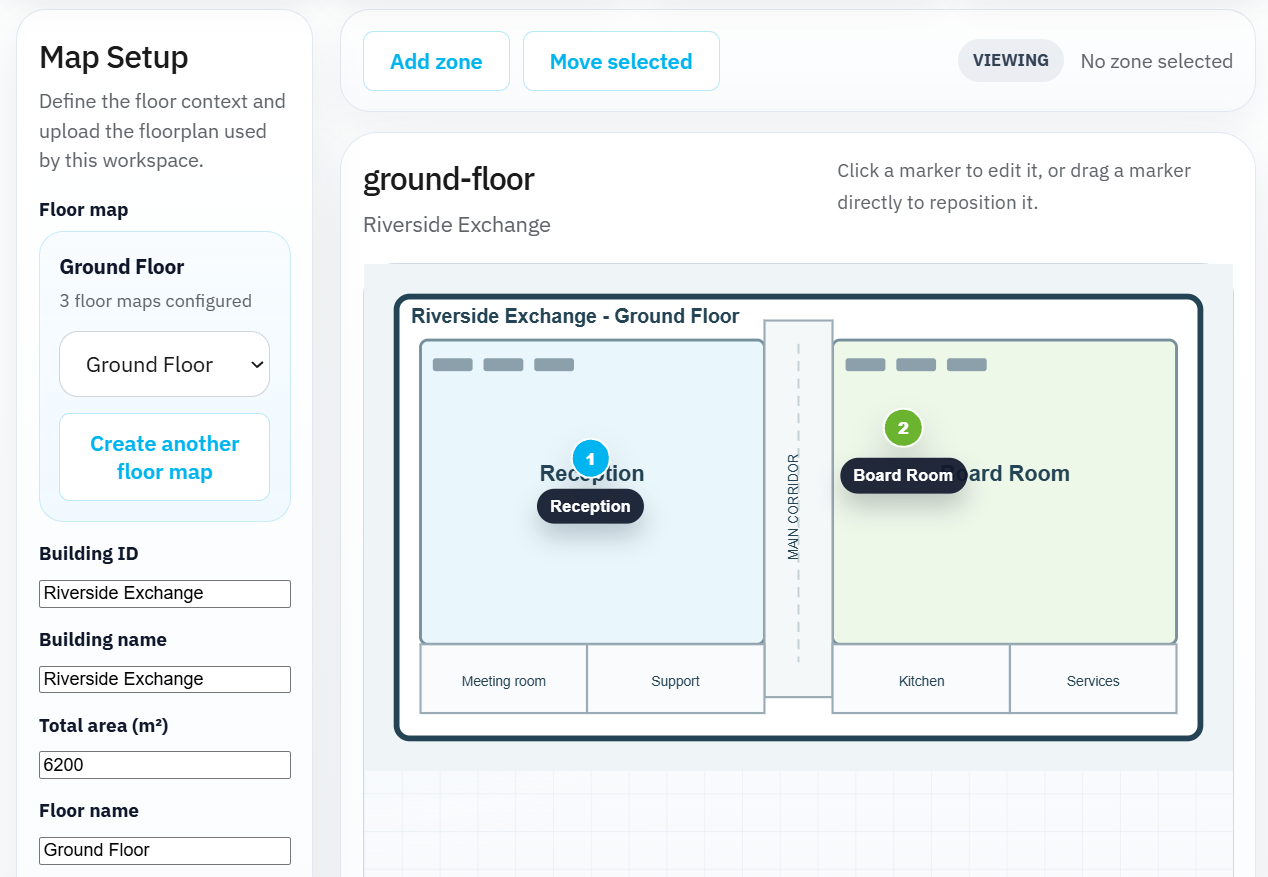
Finally, Locate gives all of that information spatial context.
A temperature reading becomes more useful when we know which room it relates to. An occupant's discomfort becomes more significant if several other people experience the same problem in the same area. An alert becomes easier to investigate when the building manager can see where it is occurring.
Entelligently V2 therefore allows floor plans to provide a spatial framework through which rooms, zones, sensors, connected entities and issues can be associated with the physical building.
See the building, not just the data
Bringing these sources together changes the questions we can ask.
Suppose several people repeatedly tell us that they are uncomfortable.
On its own, that is useful feedback.
But what if those people are all in the same part of the building?
What if environmental sensors show a recurring pattern at the same time?
What if it coincides with occupancy, external weather conditions or a particular operating state in the HVAC system?
The question is no longer simply:
“Is somebody uncomfortable?”
It becomes:
“Why does this part of the building repeatedly create this experience?”
That is where individual experience starts becoming building intelligence.
Artificial intelligence has an important role here, but we don't think it needs to be the headline.
AI can help identify patterns across comfort feedback, environmental measurements, operational information, location and time. As sufficient information becomes available, it can support understanding of what has happened, identify relationships that might otherwise be difficult to see and help anticipate conditions likely to cause future problems.
There is growing independent research into this combination of building data, digital twins, AI and occupant comfort. Recent research at the Qatar University Sports and Events Complex, for example, combined sensor and BMS data, building simulation, artificial neural networks and multi-objective optimisation within a digital-twin framework to consider energy consumption and thermal comfort together. The approach and results are independent of Entelligently, but the research demonstrates the wider potential of bringing these previously separated sources of building intelligence together.
For Entelligently, though, the objective isn't to create the most complicated digital twin possible.
It is to make the building easier to understand.
From everyday complaints to operational patterns
For a building manager, some of the most persistent performance problems can be surprisingly ordinary.
Take a meeting room where people regularly complain that they feel tired.
The original Entelligently trial actually encountered something very similar.
In one meeting room an occupant reported feeling hot and sleepy when the measured CO₂ concentration was 1,607 ppm. In another meeting room, an occupant reported feeling hot, sleepy and having sore eyes when CO₂ reached 1,982 ppm. The report identified the elevated CO₂ as a possible contributor to the experience and examined how conditions changed through the meeting.
That is much more useful than simply knowing that someone didn't like the meeting room.
It gives the building manager something to investigate.
And the underlying cause of building-performance problems is not always sophisticated.
An air outlet might have been covered because somebody sitting beneath it felt cold.
Furniture or storage might obstruct airflow.
A sensor might have been covered, moved or affected by a change in the way the space around it is being used.
Or consider something as simple as a window restrictor.
Window restrictors perform an important safety function by preventing a window opening sufficiently for a person or object to fall through it. But in some buildings the restriction can also prevent the top of a window from opening as originally intended, reducing the natural airflow available to the room.
Nothing is necessarily “broken”.
The safety measure is doing its job. The window still opens. There may be no BMS alarm and no maintenance fault.
Yet the ventilation strategy envisaged when the building was designed may no longer be operating in quite the same way.
That brings us straight back to the gap between design intent and lived performance.
Entelligently does not need to automatically know that a window restrictor, obstructed outlet or covered sensor is the cause.
Its role is to help reveal that there is a pattern worth investigating.
If occupants repeatedly report stuffiness or tiredness in one room, while CO₂ rises when that room is occupied, the building manager has a much better starting point for investigation.
If people in one zone repeatedly report being cold despite apparently acceptable temperature readings, that too becomes something worth understanding.
Instead of treating each report as an isolated complaint, Entelligently can help building managers ask:
What keeps happening here, what information do we have around it, and what might we do differently?
Over time, that creates the opportunity to move from reactive facilities management towards something more strategic: identifying recurring issues, investigating likely causes, prioritising interventions and seeing whether the actions taken actually improve people's experience.
From understanding to proportionate action
Finding a pattern is only useful if it helps someone decide what to do next.
And more building data is not automatically better building management.
Facilities and estates teams already have information competing for their attention: BMS alarms, maintenance requests, energy dashboards, compliance requirements, sensor platforms and requests from building users.
Entelligently should make that information more useful, not simply create another dashboard to watch.
A likely comfort issue might initially require nothing more than a Snudge.
If that resolves the immediate problem and the occupant subsequently reports being comfortable, there may be no need for the facilities team to become involved.
But if the problem persists, Entelligently can progressively bring more information into the analysis.
Have other occupants reported the same experience?
Is there a corresponding environmental pattern?
Does it happen in the same place or at the same time?
What are the building systems doing?
Has it happened before?
Does something now need investigation?
This allows the response to be proportionate to the problem.
There is also an important distinction between understanding a building and controlling it.
We think about that progression as:
Read → Analyse → Recommend → Request → Control
Those stages are not interchangeable.
In one deployment, Entelligently might read information from an existing system and recommend an action to the building manager.
Elsewhere, there may be permission for Entelligently to request a change.
In a suitably configured environment, a greater degree of interaction with building controls may eventually be appropriate.
But V2 should not be understood as an autonomous AI system taking unrestricted control of a building.
The level of interaction should reflect the building, the systems connected to it, the confidence in the information available and, importantly, the authority given to Entelligently by the people responsible for operating it.
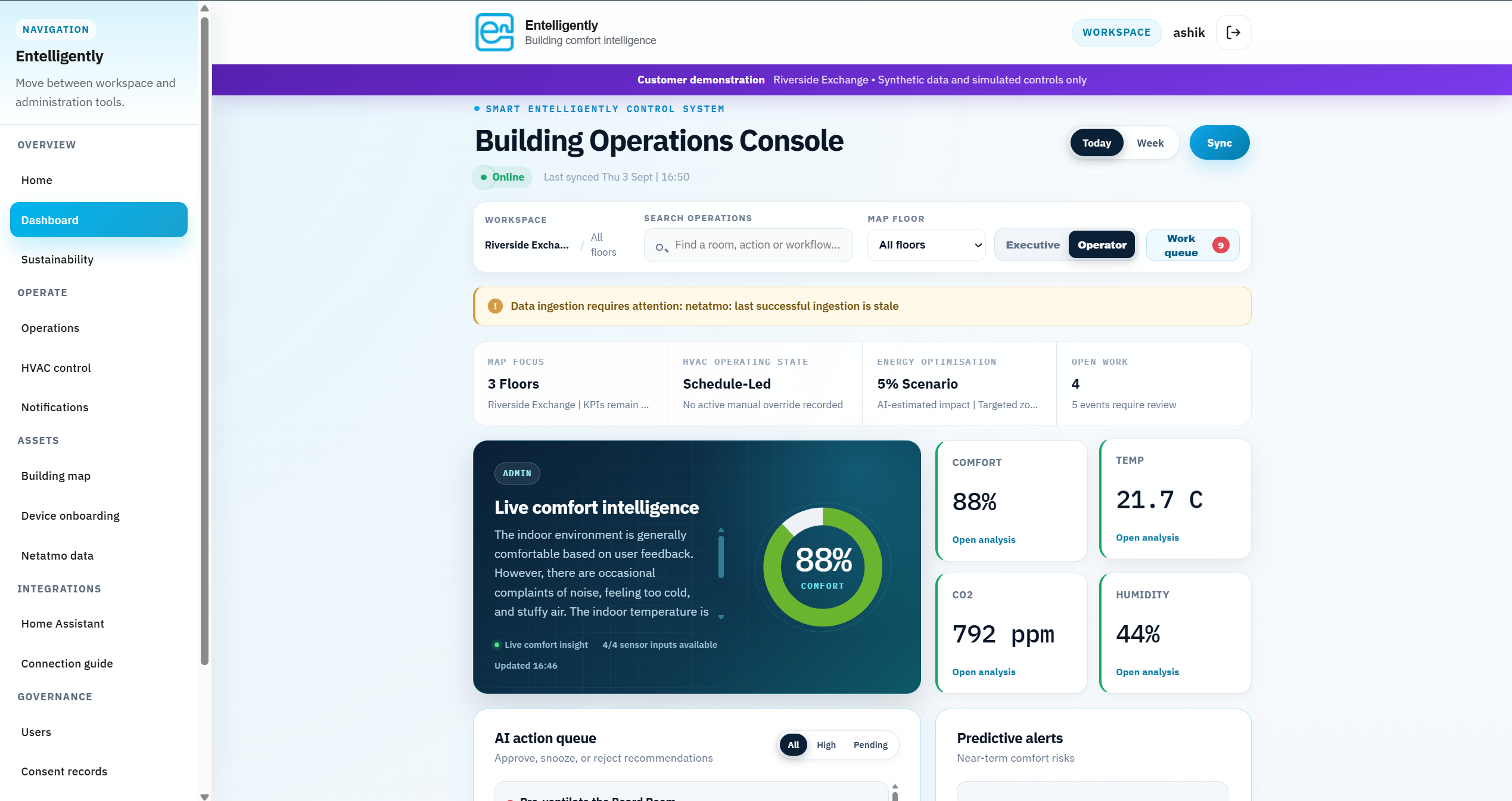
There is an important contrast between this image and the occupant interaction shown earlier.
For the occupant, Entelligently can remain remarkably simple:
How comfortable are you?
Behind that simple interaction, the building manager can potentially develop a much richer understanding of what is happening.
Start with what you have. Add what you need.
None of this requires every building to begin with a sophisticated digital twin.
That matters because one of the barriers to smart-building projects can be the assumption that everything has to be connected before useful work can begin.
Entelligently is deliberately intended to develop progressively.
A building can begin with comfort feedback.
That starts to reveal how people experience different spaces.
Add environmental sensors and we gain objective context.
Connect relevant building systems and we can start to understand what the building was doing at the time.
Add the spatial digital-twin layer and those different sources can be related to the rooms, zones and physical places where problems actually occur.
In simple terms:
Listen → Sense → Connect → Locate
This is not a package hierarchy, and every deployment does not need to reach the same level.
One trial partner may already operate a sophisticated estate with extensive BMS and IoT infrastructure.
Another may have relatively little beyond floor plans and a small number of environmental sensors.
Both could be interesting places to start.
Start with what you have. Add what you need.
For building managers, that means Entelligently does not have to begin as a rip-and-replace technology project. Where useful infrastructure already exists, the aim is to complement it and make more of the information it already produces.
Building on what we learnt
Entelligently V2 is a substantial technical evolution, but it isn't a departure from the thinking behind the original platform.
The original work included real-building trials and the development of predictive comfort models alongside Smart Nudges.
Those trials produced encouraging results, but also taught us to be careful about simplistic conclusions.
In the South zone of the September 2017 trial, for example, 47% of responses were comfortable compared with 34% the previous month.
Electricity consumption on the first floor where the pilot was operating was also 2,878 kWh during September, compared with 2,998 kWh in August: 4% lower. The report explicitly noted that further analysis was required to determine whether this was an anomaly or the beginning of a trend.
We therefore don't claim that Entelligently caused a 4% reduction in energy consumption.
The more important legacy of the work is the understanding it gave us of the relationship between people, place and building performance.
The trial data sometimes revealed relationships between environmental conditions and reported experience. At other times people responded differently to apparently similar conditions, or reported comfort when the environmental information might have suggested otherwise.
That isn't a failure of the idea.
It demonstrates why human comfort is difficult to reduce to a single sensor reading or universal setpoint.
Buildings are complicated.
People are complicated.
And the relationship between them changes with location, time, weather, occupancy, behaviour and individual preference.
V2 gives Entelligently substantially more context with which to understand that relationship.
Much of the development of the new platform has been led by Ashik Sunilkumar, lead developer for Entelligently V2 at KnowNow Information, taking the original concepts around comfort, prediction and Smart Nudges and developing them into a broader platform capable of incorporating environmental sensors, connected building information and spatial digital twins.
The next stage, however, cannot happen through software development alone.
We need more buildings.
We are looking for trial partners
We are now looking for forward-thinking organisations interested in exploring Entelligently V2 with us in real operational environments.
We are particularly interested in commercial property owners and managers, universities and campuses, local authorities and public-sector estates, healthcare and defence estates, facilities-management teams, and organisations working with building controls and BMS technologies.
And we are interested in the awkward problems.
The meeting room that people always seem to find stuffy.
The part of the office where people complain about being cold even though the BMS says everything is normal.
The building with plenty of sensors but where it remains difficult to understand what all that data actually means for the people inside it.
The estate with different systems that don't provide a coherent picture.
The building that works broadly as designed, but where experience suggests something isn't quite right.
These are potentially very interesting places to explore Entelligently.
A trial does not require a fully connected smart building.
We might begin with occupant feedback and a modest number of environmental sensors.
Where suitable systems already exist, we can explore connecting to them.
Where spatial understanding is important, we can investigate how floor plans and digital-twin information help relate problems to the physical estate.
The purpose is not simply to install some software and declare the trial complete.
It is to learn together.
Different buildings have different systems, occupants, operating patterns, constraints and problems. Working with trial partners will help us understand where Entelligently creates the most useful insight and where the platform should develop next.
For a building manager, we think the proposition can ultimately be expressed very simply.
Entelligently brings together:
what people are experiencing,
what the building is doing,
and where it is happening.
That creates the potential to move from isolated complaints and disconnected data towards a much richer understanding of how a building is really performing.
And from understanding comes the opportunity for better decisions, proportionate interventions and buildings that work better for the people using them.
If you manage a building, estate or campus where that is worth exploring, we would like to talk.
Request a demo and talk to us about becoming an Entelligently V2 trial partner.